course overview :
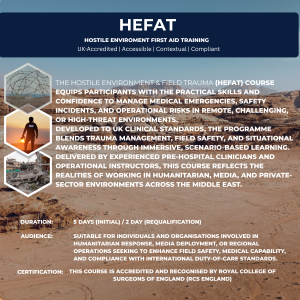
Intermediate Trauma and Casualty Care for Field Teams is an intensive two-day programme designed for experienced NGO personnel, team leaders, and field responders who operate in high-risk, remote, or resource-limited environments where serious injury or trauma is more likely.
This course provides enhanced knowledge, practical skills, and decision-making confidence above standard first aid, bridging the gap between basic first response and advanced pre-hospital care. It equips participants to recognise, assess, prioritise, and manage time-critical trauma, while understanding their limitations and coordinating higher-level medical support when needed.
The course uses the internationally recognised M.A.R.C.H. approach (Massive Haemorrhage, Airway, Respiration, Circulation, Head and other injuries) — a simple, structured method originally developed by UK Special Forces and now adopted by emergency services worldwide — ensuring field teams can act decisively and systematically under pressure.
Training is scenario-based, immersive, and evidence-driven, with realistic casualty simulations using live role players to replicate the challenges of real field operations.
Duration :
- 2 days initial training
- 1 day annual refresher
- 3-year certification validity
CReated For :
NGO field responders and team leaders
Security and safety personnel in remote or high-risk environments
Staff needing enhanced trauma capability above standard first aid
What you will learn:
- Role and responsibilities of a field trauma responder
- Mechanism of injury, kinematics and injury pattern recognition
- Scene assessment, safe approach and immediate actions
- Massive haemorrhage control (direct pressure, wound packing, tourniquets)
- Airway assessment and management (manual techniques, oropharyngeal & nasopharyngeal airways)
- Thoracic trauma recognition and management (chest seals, emergency oxygen use)
- Circulatory assessment, managing internal/external bleeding and shock
- Head and other injuries (pain assessment, minor and thermal injuries, musculoskeletal injuries, cold/heat exposure, helmet removal, basic immobilisation)
- Full casualty assessment/reassessment and history taking
- Basic Life Support including CPR, AED use, pit crew resuscitation and airway management with bag-valve mask
- Management of choking, common respiratory conditions and major illnesses
- Safe use of emergency oxygen (indications, dosage, monitoring and safety)