course overview
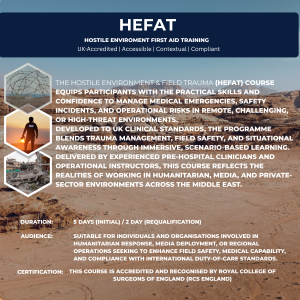
An intensive 4-day programme designed for experienced field leaders, security personnel, and high-risk deployment teams who may need to manage multiple casualties and complex trauma cases in remote or hostile environments. Participants develop advanced airway management, bleeding control, thoracic injury management, and multi-casualty command skills. Training is fully immersive and scenario-based, replicating the pressures and unpredictability of real-world incidents
This course delivers practical, scenario-driven and evidence-based training tailored to the real conditions, challenges, and risks that NGO staff face during day-to-day field operations.
It introduces a clear, structured and rapid approach to casualty care that helps responders quickly identify and prioritise life-threatening conditions, while avoiding missed injuries or illness. It empowers staff to provide immediate, effective first-line care, buying time for advanced support and improving patient outcomes.
Our approach is hands-on, immersive, and scenario-based — proven to embed knowledge, build confidence, and ensure field teams retain critical skills they can apply under pressure. This style of learning has already been adopted by the emergency services and is now adapted to meet the needs of the humanitarian sector.
Duration :
- 4 days (initial)
- 1 day annual refresher
- 4-day requalification
CReated For :
Senior NGO field staff
Security teams
High Risk deployment leaders
What you will learn:
Roles and responsibilities of an advanced field responder
Safe approach, scene assessment, triage and kinematics
Massive haemorrhage control
Airway assessment and management (manual, OP/NPA/Supraglottic airways, BVM ventilation)
Respiratory assessment and thoracic trauma management (chest seals, oxygen therapy, pulse oximetry)
Circulatory assessment and management of internal/external bleeding and hypovolaemic shock
Head and other injuries (minor/thermal injuries, musculoskeletal trauma, splinting, helmet removal, cold/heat exposure)
Casualty reassessment, history taking, and handover to emergency services – Basic and Immediate Life Support (adult, child and infant), pit crew resuscitation, AED use, post-resuscitation care
Recognition and management of choking and common medical emergencies